
Growing relationship with your land through ritual return, patient attention, and the courage to listen
WHAT THIS IS
This is an invitation to spend four weeks building relationship with a Place - your land, your garden, the patch of earth you walk past daily, the ground beneath your feet that you’ve been too busy to meet.
Like the Little Prince and his fox, relationship is built through ritual return. Coming back to the same spots. Sitting at a little distance. Letting the place reveal itself slowly. Growing apprivoisé - the French word that means befriending through patient familiarization. Not taming. Not mastering. Growing mutual. Accepting to be changed by the process in return.
You’ll move through four elements - Earth, Water, Air, Fire - not as literal and technical assessment of land as an asset. But as mnemonic lenses for deepening relationship. Each week offers practices you can choose from based on what calls to you, what the weather allows, what time you have. Some days you might spend an hour. Some days, five minutes. The practice is in returning, not in perfection.
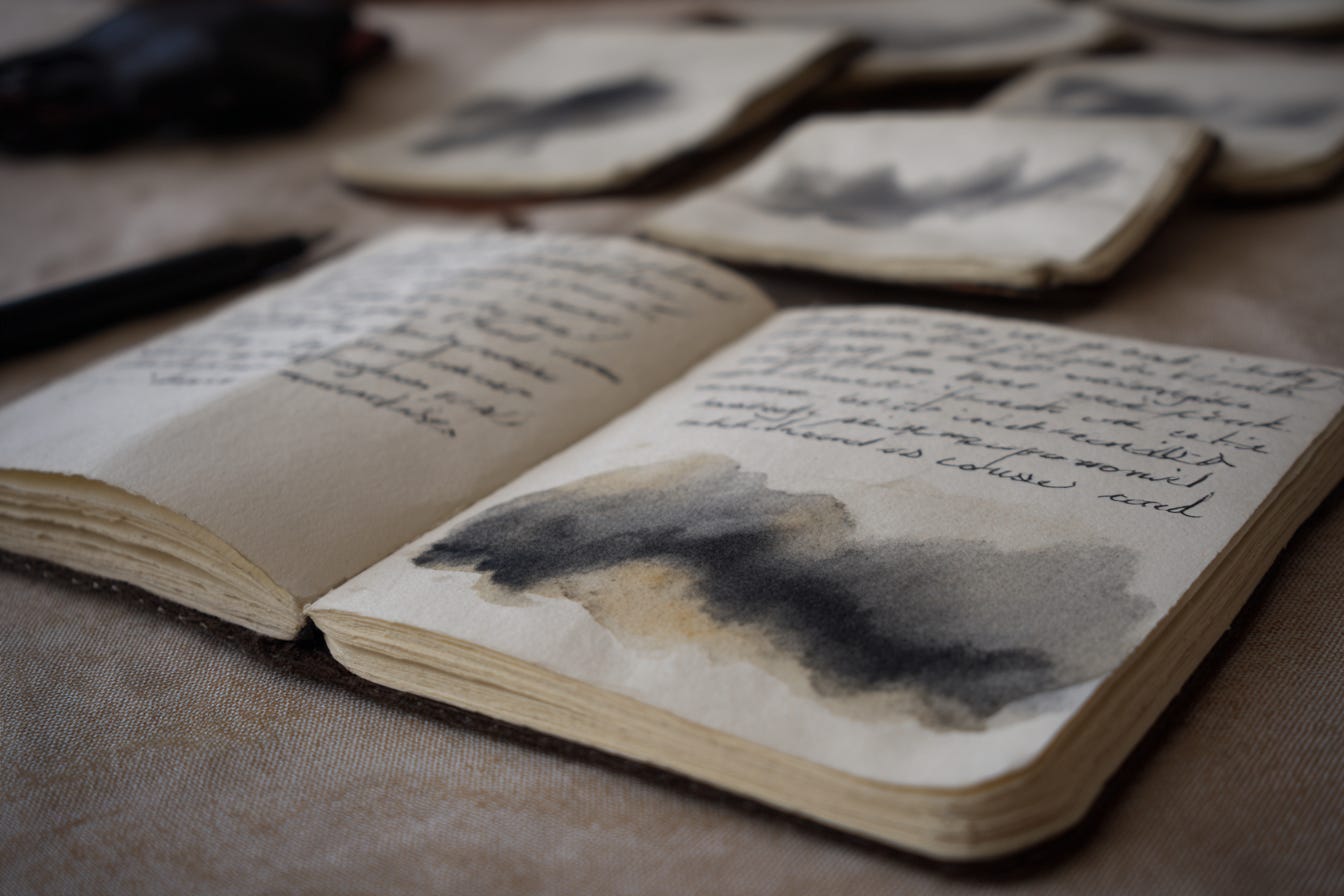
Your journal becomes a commonplace notebook - a place where you collect what you find (leaves, stones, questions, sketches, words) and reflect on what it means. Evidence of presence. Proof of paying attention.
For those who want to go deeper:
Deep 1-1 calls where we talk about your sense of belonging. The places you feel attached to. And the decisions laying ahead of you.
The Little Prince provides the governing metaphor: apprivoiser, befriending through patient return. The fox teaches: “You become responsible forever for what you have tamed.” (“Tamed“ is much too harsh a translation! - apprivoiser is a bond). The befriending happens slowly, through ritual, through attention, through the willingness to be changed by the relationship.
The four elements give structure without rigidity: Earth, water, air, fire are ancient lenses humans have used for thousands of years to understand the world. They’re not scientifically precise. They’re mythologically powerful. They work because they give you a way to organize attention.
The practices draw from multiple traditions:
Nature journaling techniques (adapted for relationship-building rather than observation)
Listen to Your Land methodology (which you can access the full year practice of by subscribing to paid)
Commonplace notebook tradition (collecting what matters, reflecting on meaning)
Contemplative practice (presence, ritual return, patient attention)
The journal becomes the physical manifestation of your internal working model - your mental representation of relationship with this place. That’s not data about the place. It’s data about the relationship.
Which is the whole point.
THE STRUCTURE
Four weeks. Four elements. Flexible practices.
Each week centers on one element as a way of seeing and being with your place:
Week 1: EARTH - grounding, boundaries, what holds
Week 2: WATER - flow, emotion, what moves through
Week 3: AIR - breath, perspective, what speaks
Week 4: FIRE - transformation, decision, what changes
You won’t do every practice. You’ll choose what resonates. Some practices you might return to multiple times. Others you might skip entirely. Trust your instinct about what your place is asking you to notice.
Each practice is tagged so you can scan quickly:
Activity type: Movement, Stillness, Visualization, Making, Writing
Time needed: Quick (5-15 min), Medium (20-30 min), Deep (45-60 min)
Example: Movement | Ritual | 20 minutes means this practice involves moving through your land, has a ritual quality, and takes about 20 minutes.
For those who want to go deeper:
Deep 1-1 calls where we talk about your sense of belonging. The places you feel attached to. And the decisions laying ahead of you.
WHAT YOU NEED
Essential:
A journal (any kind - cheap notebook, fancy sketchbook, whatever)
Time on your land (15-45 minutes, a few times per week)
Willingness to sit still and pay attention
Optional supplies (as per your inclinations):
Collecting bag for walks (a pretty box for storing if you fancy that)
Glue or tape for collaging found objects
Colored pencils or pens (if you want them)
Camera or phone (if drawing feels wrong)
Pen for journaling, Timer for meditating, Blanket for staying out, Hygge, Walking boots.
What you don’t need:
Artistic skill
Scientific knowledge
“Your own” land (borrowed land, public land, land you visit regularly all work)
Certainty about what you’re doing
PRACTICAL NOTES
When to start: The workshops begin in January (first week of Earth). But you can start whenever you’re ready. The practices work in any season, though the language here is written for winter.
How often: As often as you can return. Three times a week is good. Daily is better if you have the capacity. Once a week works if that’s what’s possible. The practice is in returning, not in how often you return. And in keeping the heart there (let the subconscious do the heavy lifting).
How long: Some practices take 15 minutes. Some take an hour. The visualizations take 45-60 minutes. Do what your life allows. Five minutes of presence is more valuable than an hour of distraction.
What if I miss days: You miss days. Everyone misses days. The journal doesn’t care. It’s normal. Return when you can. Don’t turn this into one more thing to feel guilty about.
What if I don’t have “my own” land: You don’t need to own land to practice place journaling. Borrowed land works. Public land you visit regularly works. The corner of a park where you walk your dog works. The practice is relationship, not ownership.
What if I’m not good at drawing/writing: You don’t need to be good at anything. This isn’t art class. Draw stick figures if that’s what comes. Write sentence fragments. Glue things in and don’t add words. Or rekindle your passion for watercolor full on:)
What if nothing happens: Something always happens, even if it’s subtle. If you sit on your land for 15 minutes and “nothing happens,” write that. Write: “I sat for 15 minutes and nothing happened.” That’s data. That’s the beginning of noticing.
For those who want to go deeper:
Deep 1-1 calls where we talk about your sense of belonging. The places you feel attached to. And the decisions laying ahead of you.
THE JOURNAL AS COMMONPLACE NOTEBOOK
Your journal isn’t precious art. It’s not performance. It’s not for anyone else to see unless you choose to share it.
It’s a commonplace notebook - a practice of collecting what matters. Quotes, observations, pressed flowers, sketches, questions, diagrams, seeds, stones, the muddy print of your hand after touching earth.
Evidence of presence. Proof you were paying attention. The physical manifestation of relationship-building. An artifact you look at again in ten years and it makes you weep a bit and fills your soul.
Some pages will be beautiful. Some will be messy. Some will focus on a single theme, some will waltz through many days which just a line or two for each item. All of that is valid.
AFTER THE FOUR WEEKS
What You’ll Have
A journal full of evidence. Questions you’re still sitting with, good questions. A few decisions that clarified. A relationship that didn’t exist four weeks ago.
You’ve traveled through scales (atomic to planetary) and through time (geological past to deep future). You’ve sat with difficulty and with beauty. You’ve collected pieces of the place and pieces of yourself in relation to the place.
Your attachment pattern is visible now. You know whether you’re oriented toward the past (memories, who you were here) or the future (plans, who you’ll become here) or transitioning between relationships. You know what anchors you and what repels you. You know where the place speaks clearly and where it stays silent.
For those who want to go deeper:
Deep 1-1 calls where we talk about your sense of belonging. The places you feel attached to. And the decisions laying ahead of you.
How the Relationship Continues
The four weeks are a structure for beginning. The relationship continues beyond structure.
Some people will want to repeat the cycle - do it again in spring when the land wakes, in summer when everything is abundant, in fall when things die back. The same practices reveal different things in different seasons.
Some people will develop their own rhythm - returning to specific practices that resonated (the scale journey, the deep time visualization, the boundary walk) whenever they need perspective.
Some people will simply know now: I need to return to this spot regularly. I need to sit still sometimes. I need to listen before deciding. The practices taught you how to listen. Now you listen in your own way.
The Longer Work
… And for some people, four weeks of place journaling reveals: I need the full Listen to Your Land methodology. I need help understanding this place’s ecological systems, its patterns, its possibilities. I’m making major decisions about this land and I need support. I need to work with Jo.
That’s the deeper work. Place Journaling is the beginning - the relationship-building that precedes technical understanding. Listen to Your Land is the full methodology - pattern recognition, regenerative design, strategic decision-making grounded in what the place is actually asking for.
But you can’t do that work without relationship first. You can’t listen to technical signals (water, microclimate, soil, biodiversity) if you don’t know how to listen. Place Journaling teaches listening.
Brilliant framing of place-based attention! Reframing apprivoiser as mutual befriending rather than mastery really shifts the whole practce from extraction to reciprocity. The insight that returning matters more than perfection sidesteps the productivity trap alot of journaling advice falls into.